

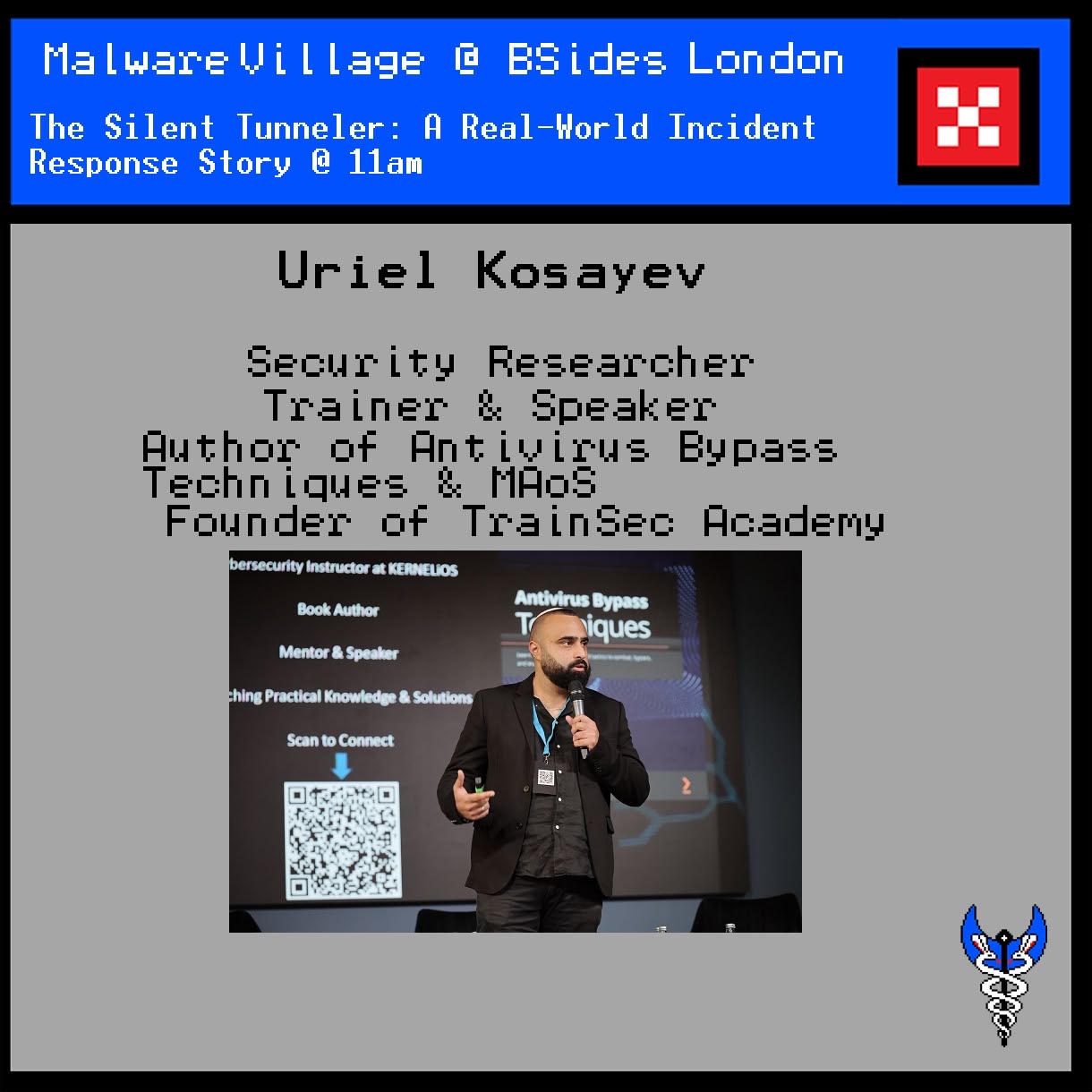
I am Uriel Kosayev, co-founder of TrainSec Academy and author of Antivirus Bypass Techniques and MAoS: Malware Analysis on Steroids. On Saturday, December 12, I am lecturing at BSides London 2026, in the Malware Village, with “The Silent Tunneler: A Real-World Incident Response Story”. In this post I want to give you a taste of what the session is about, why this kind of case matters for every defender, and where you can go deeper.
What Is The Silent Tunneler About?
Now, this is not a lecture about theory. The Silent Tunneler is built on a real incident response investigation, and I walk through it the way it actually happened: the initial discovery, the technical analysis, and the response process.
The title gives you a hint about the adversary. If I’m as an attacker, I do not want my traffic to look like an attack. I want it to blend in, to tunnel quietly through channels the defenders already trust. This is why these cases are so hard: the signal that starts the investigation is small, almost boring, and the real story only shows up when you start pulling the thread. So in this session we pull that thread, and you see how a small anomaly turns into a full incident response engagement.
An earlier version of this story ran as a workshop at the DEF CON 34 Malware Village in August. BSides London is its next stop.
Why Are Tunnels So Hard to Catch?
Basically, a tunnel hides one protocol inside another. Let’s say the attacker wraps their command and control traffic inside DNS queries or inside normal-looking HTTPS sessions to a domain nobody has a reason to block. From the firewall’s point of view, it is just another lookup, just another web request.
Now, if I’m as an attacker, this gives me three things at once: a way out of the network, a way back in for my commands, and a very good chance that nobody looks twice. Of course, the tunnel still leaves traces. They are just quiet ones:
– A process that has no business talking to the network, talking to the network.
– Connections at a regular rhythm, the kind of heartbeat a human user never produces.
– Volume or request patterns to one destination that do not match what that destination normally gets from your environment.
– Long, random-looking names or payloads where you would expect short, readable ones.
None of these is a verdict on its own. This is why the analyst’s job is to correlate them: which process, which user, since when, and what else changed on that machine at the same time. So the skill that wins these cases is not one tool. It is knowing your baseline well enough that a quiet deviation stands out.
Session Details
– Event: BSides London 2026 – Date: Saturday, December 12, 2026 – Track: Malware Village – Time: 11:00 AM London time (UTC) – Session: “The Silent Tunneler: A Real-World Incident Response Story”
What This Means Practically
– Know which processes in your environment are expected to make network connections, and treat the rest as questions. – Look at timing and volume, not only at destinations. Tunnels often hide in the pattern, not in the address. – Correlate network signals with process, user and host activity before you call something a true positive or a false positive. – Turn every confirmed finding into a detection rule, so the next tunnel is caught earlier.
Keep Learning: Go Deeper Than One Session
One session can show you how an investigation feels. Building the skill set behind it takes structured work. If you are starting out on the defensive side, SOC Analyst Professional: Foundations builds the baseline knowledge and triage mindset this whole case rests on. If you want to dissect the kind of malware that shows up in these incidents, Malware Analyst Professional Level 1 teaches static and dynamic analysis from the ground up. And if you want to turn what you find in an investigation into rules that catch the next one, Detection Engineering Professional takes you there. For a quick look at how the blue, purple and red sides fit together, read Detection Engineering: Blue, Purple and Red Team here in the library.
If you don’t know the foundations, you’re not in the game. So build them, and the quiet signals start to look loud.
